Unhurried and Unfiltered: The Case for Spending an Entire Evening With Just Two Glasses of Wine
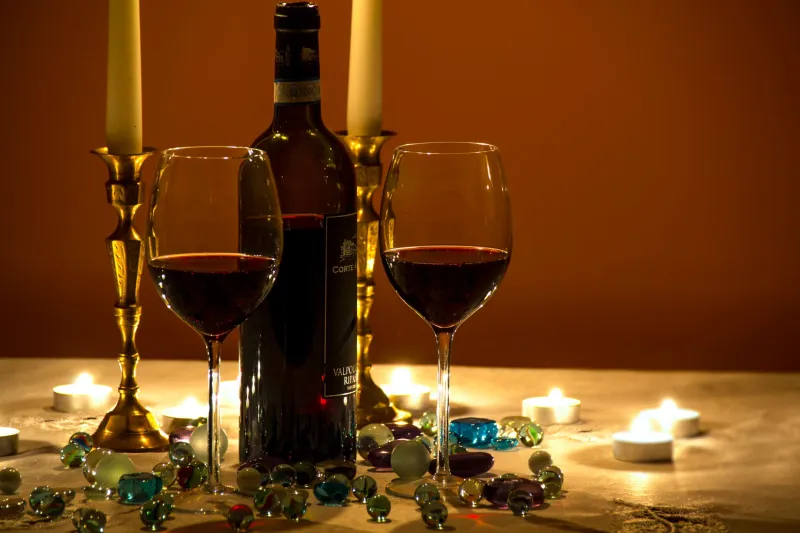
There is a particular kind of evening that most Americans have never quite allowed themselves to experience. It does not involve a countdown clock, a bottomless carafe, or a happy-hour window that slams shut at seven o'clock. It involves a comfortable chair, a thoughtfully chosen glass of wine, and the radical act of simply staying put.
In much of Europe — in the wine bars of Lyon, the enoteche of Florence, the bodegas of Seville — an evening built around one or two exceptional pours is not considered restrained. It is considered civilized. The wine is the event. The conversation deepens around it. The food arrives unhurried. Time, for once, cooperates.
At Annabel's Wine Bar, we have spent considerable thought on how to bring that sensibility to an American audience. And the first step, we would argue, is simply making the case that slowing down is not a sacrifice. It is, in fact, the whole point.
Why Speed and Wine Are Fundamentally Incompatible
Flavor perception is not instantaneous. The human palate requires time — and, crucially, attention — to register the full complexity of what a well-made wine is offering. When you rush through a glass, you are, in the most literal sense, tasting less of it.
This is not merely a philosophical observation. Research in sensory science consistently demonstrates that distraction and speed suppress the brain's ability to process aromatic compounds. The retronasal olfaction that makes wine so dimensionally rich — that process by which aromas travel from the back of the mouth upward into the nasal cavity — functions best when a person is still, attentive, and unhurried. In other words, the wine rewards the diner who gives it time.
Consider what happens when you pour a glass of a structured Burgundy or a textured white Rhône and simply hold it for a moment before drinking. The aromas evolve. The wine opens. Something that initially presents as closed or austere begins to reveal itself. You did not change the wine. You changed your relationship to it.
Engaging All Five Senses — Not Just Taste
The most common mistake made at wine bars, particularly by those newer to the experience, is treating wine as a beverage rather than a subject. A beverage is consumed. A subject is explored.
Begin with sight. Tilt the glass against a white background — a napkin, a menu, even the tablecloth — and observe the color. Is it deep garnet or translucent ruby? Does the white wine carry a golden hue that hints at oak aging, or is it pale and crystalline? Color communicates age, grape variety, and winemaking choices before a single drop reaches your lips.
Move to scent. Swirl the glass gently to volatilize the aromatic compounds, then lower your nose into the bowl and inhale slowly. Do not rush toward a conclusion. Let the aromas arrive in sequence. What presents first — fruit, earth, florals, oak? What lingers beneath? A skilled winemaker has layered these elements deliberately, and they deserve the same deliberate attention in return.
Only then should you taste — and even then, resist the urge to swallow immediately. Allow the wine to coat your palate. Notice where you perceive acidity, where tannins grip, where sweetness or minerality asserts itself. The finish, that lingering impression after the wine is gone, is often where the most interesting conversation happens.
Building an Evening Rather Than Filling a Glass
One of the most practical shifts a wine bar visitor can make is to stop thinking in terms of quantity and start thinking in terms of architecture. A well-constructed wine bar evening has a shape to it — a beginning, a middle, and a satisfying conclusion.
Consider opening with something light and high-acid: a crisp Muscadet, a Grüner Veltliner, or a restrained Chablis. These wines prepare the palate rather than overwhelm it. They are conversation starters, both literally and figuratively.
From there, allow the evening to deepen. A second glass might move toward something more structured — a Côtes du Rhône, a Barbera d'Asti, or a domestic Pinot Noir from the Willamette Valley. The food, ordered in stages rather than all at once, should complement rather than compete. A charcuterie selection alongside that first glass. A composed small plate — perhaps something with aged cheese or roasted vegetables — to accompany the second.
This is not an elaborate or expensive formula. It is simply an intentional one. And intention, more than budget or expertise, is what separates a memorable wine bar evening from a forgettable one.
The European Lesson America Is Finally Ready to Learn
For decades, American drinking culture has operated under assumptions that are only now beginning to loosen. The assumption that more is better. That efficiency is a virtue even in leisure. That a night out should be measured by its pace rather than its quality.
Those assumptions were never particularly well-suited to wine, a product that has been made, traded, and contemplated for thousands of years and that has never once benefited from being rushed. The Europeans understood this intuitively. Americans, increasingly, are beginning to understand it as well.
The rise of dedicated wine bars across the United States — establishments that prioritize curated lists, knowledgeable staff, and an atmosphere designed for lingering — reflects a genuine cultural shift. People are seeking depth over volume. They want to understand what they are drinking, not simply consume it.
At Annabel's, that shift is precisely what we have built our space around. Our wine list is assembled with the deliberate drinker in mind. Our staff are trained not to rush a table, but to guide one. Our menu is designed to be ordered in stages, over time, without apology.
A Simple Invitation
If you have never spent an entire evening at a wine bar with the explicit intention of going nowhere fast, we would like to extend a straightforward invitation: come in, choose one glass with care, and see what happens when you give it the attention it deserves.
Order something to eat. Let the conversation find its own pace. When the glass is empty, consider whether you want another — not because the hour demands it, but because you are genuinely curious about what comes next.
That curiosity, unhurried and unforced, is the essence of what a wine bar evening can be. Annabel's will be here, as long as you need us to be.