The Wine List's Best-Kept Secret: A Case for Skin-Contact Whites You've Been Overlooking

The Wine List's Best-Kept Secret: A Case for Skin-Contact Whites You've Been Overlooking
There is a particular kind of wine that sits near the bottom of the white wine section on many thoughtfully assembled lists — listed without fanfare, occasionally with a brief tasting note that includes the word amber or tannic, and almost always passed over by guests who assume it is either a mistake or an acquired taste meant for someone else. That wine is the skin-contact white, and the assumption, it turns out, is entirely wrong.
Skin-contact wines have traveled a considerable distance to reach your table. What began as a practice associated almost exclusively with small natural wine producers in Georgia, Slovenia, and the Italian region of Friuli has, over the past decade, found its way onto the lists of serious wine bars from Portland to New Orleans. The style is no longer a curiosity. It is a category — and one that rewards the drinker who is willing to spend a few minutes with it.
What Skin Contact Actually Means
To understand why these wines taste the way they do, it helps to understand one fundamental difference in how they are made. When white wine is produced conventionally, the grape skins are removed almost immediately after the fruit is crushed. The juice ferments on its own, producing the clean, pale, often delicate wines most drinkers recognize as standard white wine.
Skin-contact wines take a different path. The juice is left in contact with the skins — sometimes for a matter of days, sometimes for weeks or even months — before it is pressed and allowed to finish fermenting. During that time, the skins impart color, tannin, and a range of aromatic compounds that simply do not exist in conventionally produced whites.
The result is a wine that looks nothing like what the grape variety would typically produce. A Pinot Grigio made with extended skin contact, for instance, can emerge a deep copper or amber hue rather than the pale straw most Americans associate with the grape. The flavor profile shifts accordingly: less fruit-forward, more textural, with a savory, almost nutty character and a gentle grip on the finish that feels entirely foreign to anyone whose white wine experience has been limited to the conventional style.
That grip — the tannin — is where most first-timers pause. Tannin in a white wine feels counterintuitive, because we have been conditioned to associate it exclusively with reds. But the sensation, once you stop expecting it to be absent, is not unpleasant. It is, in fact, precisely what makes skin-contact wines such compelling partners for food.
Why the Texture Is the Point
One of the most common reasons guests avoid ordering skin-contact wines is the suspicion that they will be too strange, too challenging, or simply too different from what they came in to enjoy. This is understandable. But it misidentifies what the wine is actually offering.
The texture of a skin-contact white is not a flaw to be tolerated. It is the wine's primary argument. Where a conventional white wine refreshes, a skin-contact wine engages. It asks you to pay attention in a way that a straightforward Sauvignon Blanc does not. The layers unfold slowly — a little dried apricot here, a note of beeswax or chamomile there, followed by that long, slightly tannic finish that lingers long after the glass is set down.
For guests who have grown comfortable with wine but are looking for something that genuinely expands what they thought the category could do, this is the glass worth ordering. It is not more difficult. It is simply more interesting.
Food Pairings That Make the Case
If there is one area where skin-contact wines distinguish themselves beyond any reasonable debate, it is at the table. The tannin and texture that can feel surprising in isolation become remarkably logical when food is involved.
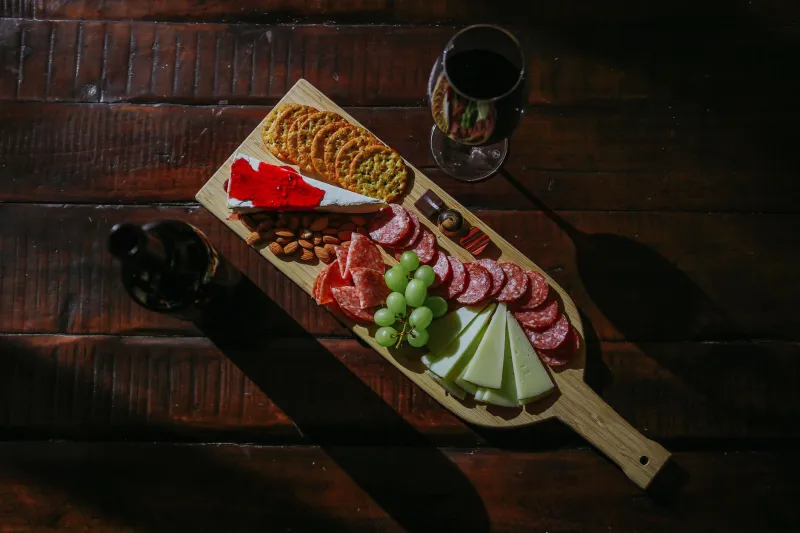
Consider the charcuterie board — a fixture on nearly every wine bar menu in the country. The fat and salt of cured meats, the funk of a well-aged cheese, the brine of olives or cornichons: these are flavors that can overwhelm a delicate white wine and clash awkwardly with a fruit-forward red. A skin-contact white, with its structure and savory depth, meets them as an equal. The wine does not disappear into the food. It holds its ground and makes everything taste more considered.
The same logic applies to dishes built around umami — roasted mushrooms, a warm lentil salad, a grain bowl with miso-dressed vegetables. These are foods that can make conventional whites taste thin and make big reds taste heavy. Skin-contact wines occupy exactly the middle ground these dishes require.
Hard and semi-hard cheeses — aged Gouda, Manchego, a sharp Cheddar — are similarly well-served. The tannin in the wine cuts through the fat in the cheese in the same way a red would, but without the weight that can make a cheese course feel like a meal in itself.
For guests dining at Annabel's who are building a meal around shared plates, a skin-contact white is often the most versatile single glass on the list. It moves across courses with an ease that neither conventional whites nor light reds can consistently match.
Where to Begin
If you are approaching skin-contact wines for the first time, a few general principles will help orient you before you speak with your server or sommelier.
First, shorter maceration times — the period during which the juice sits with the skins — generally produce wines that are closer in character to conventional whites, with just a hint of additional texture and color. These are the more approachable entry points. Wines with longer macerations, sometimes labeled amber or ramato, will be more pronounced in every dimension: deeper in color, more tannic, more savory.
Second, the grape variety matters less than you might expect. Skin contact transforms whatever it touches. A variety you have found unremarkable in its conventional form may reveal an entirely different personality when made this way. This is part of the pleasure of the exercise.
Third, ask. The staff at any wine bar worth its list will have opinions about which skin-contact wines are currently pouring well, which pair most naturally with what you are eating, and which represent the most accessible introduction to the style. This is precisely the kind of conversation a good wine bar exists to facilitate.
An Invitation Worth Accepting
The skin-contact wine on your list is not there to test you. It is not a trick or a statement. It is an invitation — from the winemaker who made it, from the sommelier who selected it, and from the list itself — to spend an evening with something that will not behave exactly as expected and will be more memorable for it.
The wines you remember longest are rarely the ones that confirmed what you already knew. They are the ones that introduced you to something you did not know you were missing. Order the skin-contact white. Stay a while with it. Let it surprise you.