The Bar Stool as Common Ground: What Happens When Americans Share a Bottle With Someone They've Never Met
The Bar Stool as Common Ground: What Happens When Americans Share a Bottle With Someone They've Never Met
There is a particular kind of evening that cannot be planned. It begins ordinarily enough — a solo visit, a seat at the bar, a glass poured with care. And then, somewhere between the first and second pour, a stranger leans over and asks what you're drinking. What follows is, in the best possible sense, entirely unpredictable.
This is the quiet magic of the wine bar counter, and it is, in many ways, a distinctly American phenomenon.
A Social Contract Written in Cork and Candlelight
Formal dining traditions — whether rooted in European custom or the more structured conventions of American fine dining — have long maintained a certain social architecture. Tables are islands. Eye contact across the room is polite but brief. The evening belongs to whoever you arrived with, and the boundaries of that arrangement are rarely questioned.
The wine bar disrupts all of that, almost by design.
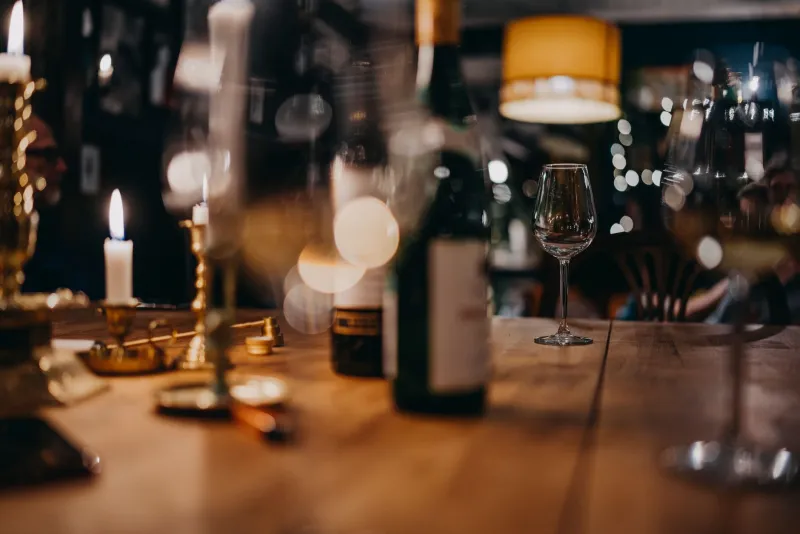
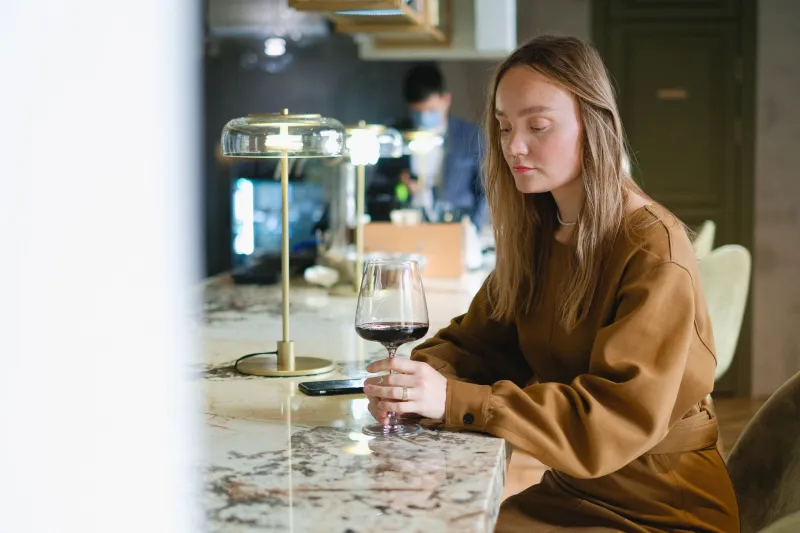
The counter, with its deliberate informality and its suggestion of shared space rather than private territory, operates by a different set of unspoken rules. Proximity is assumed. Conversation is permitted — even welcomed. The person seated to your left may be a retired schoolteacher from Ohio, a software engineer on a work trip, or a first-time visitor who has never ordered a natural wine in her life and is now deeply curious about the one you're holding. None of that matters, and all of it does.
What the bar stool offers, perhaps more than any other seat in the room, is permission. Permission to be curious. Permission to speak. Permission to let the evening become something other than what you expected.
The Bottle as Introduction
Americans have always had a complicated relationship with spontaneous intimacy. We are, as a culture, simultaneously gregarious and guarded — quick to smile, slower to open. The wine bar, perhaps because it sits at the intersection of pleasure and leisure, tends to dissolve that particular tension with unusual efficiency.
A shared bottle accelerates the process considerably.
There is something about the gesture of offering a pour to the person beside you — or accepting one — that reframes the entire social dynamic of the evening. It is not a transaction. It is not networking. It is, at its core, an act of uncomplicated generosity, and it carries with it an implicit acknowledgment: we are both here, we are both enjoying this, and perhaps that is enough to begin.
In cities like New York, Chicago, and San Francisco, where the pace of daily life rarely permits the kind of unhurried connection that used to happen more naturally, the wine bar counter has quietly become one of the last remaining spaces where that connection is still possible without effort or arrangement. You do not need a mutual friend, a shared app, or a carefully constructed icebreaker. You need a good bottle and the willingness to sit still long enough for something to happen.
Why This Is Harder to Find Than It Should Be
The forces working against spontaneous social encounter in contemporary American life are well-documented and, by now, fairly well understood. Screens occupy the spaces that used to belong to conversation. Social media has made it possible to feel perpetually connected while remaining practically isolated. Even the act of going out has, in many contexts, become a performance — an event to be photographed and shared rather than simply experienced.
The wine bar, when it is functioning at its best, resists all of that.
The counter demands a certain presence. You cannot easily retreat into your phone when someone is asking whether the Grüner Veltliner is worth trying, or whether you've visited this particular establishment before. The setting itself — the soft light, the deliberate pace, the absence of the urgency that defines so much of American public life — creates conditions in which actual conversation becomes not just possible but natural.
This is not an accident. It is, in fact, the entire point.
Strangers Who Become Something Else
Ask anyone who has spent meaningful time at a wine bar counter, and they will almost certainly have a version of this story: the evening that began alone and ended with a new acquaintance, a recommendation passed along on a scrap of paper, or a conversation that continued well past the point when either party intended to leave.
These are not dramatic stories, and that is precisely what makes them worth noting. They are the ordinary, unremarkable, quietly significant encounters that used to define the texture of American social life and that have become, in recent years, increasingly rare.
The wine bar counter does not promise transformation. It does not guarantee that the person beside you will become a lasting presence in your life. What it offers is something more modest and, in its own way, more valuable: the unscripted moment, the unexpected exchange, the evening that went somewhere you didn't anticipate.
The Equalizing Effect of a Well-Chosen Pour
There is a democratic quality to the bar stool that formal seating rarely achieves. Titles and professions recede. The question of what you do for a living, so often the first and most loaded inquiry in American social settings, tends to arrive later here — if it arrives at all. What matters first is what's in the glass, and that is a subject on which no one holds a particular advantage.
A first-time wine drinker and a seasoned collector can sit side by side at a wine bar counter and find, almost immediately, that they have something to discuss. One is curious; the other may be knowledgeable. But the exchange runs in both directions, and the person who has been ordering wine for thirty years will often tell you that they learn something new from the person who has been doing it for thirty days.
This is the bar stool as equalizer — not in any grand ideological sense, but in the simple, practical sense that it places people in proximity without hierarchy and invites them to proceed from there.
An Invitation Worth Accepting
If you have not yet allowed a wine bar evening to unfold on its own terms — without an agenda, without a fixed departure time, without the insulation of a group large enough to make outside conversation unnecessary — consider this an encouragement to try.
Sit at the counter. Order something you find genuinely interesting. And if the person beside you glances over with the expression of someone who is quietly curious about what you're drinking, let them ask. You may find that the most memorable part of the evening was the part you never planned at all.