One Glass, One Evening, One Very Good Reason to Go Alone
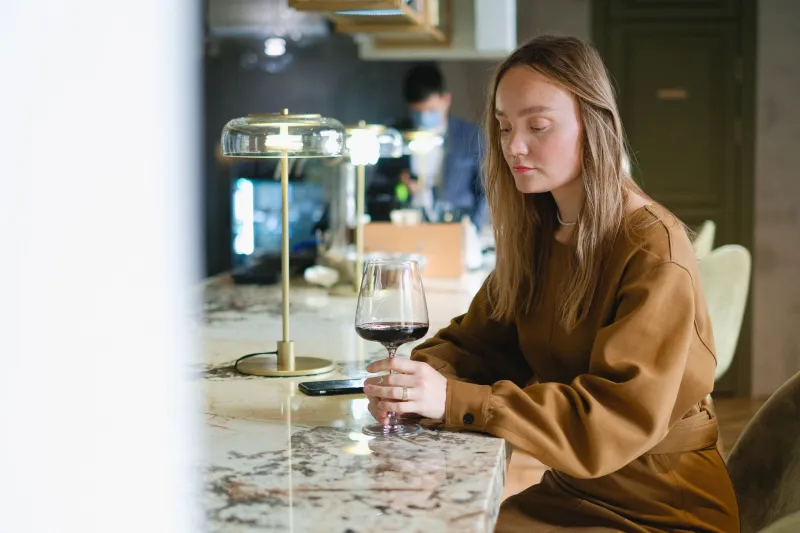
There is a particular kind of freedom that arrives the moment you settle into a seat at a wine bar knowing that no one else is coming. No one is running late. No one will glance at the list for thirty seconds and defer to you with a shrug. No one will order a second round before you have finished your first. The evening belongs entirely to you, and that is not a consolation — it is the point.
And yet, for many Americans, the solo dining reservation carries a faint social stigma that simply refuses to dissolve. The instinct is to apologize for it: to arrive phone in hand, to choose a corner seat, to project an air of waiting for someone who will never materialize. It is a cultural habit worth examining and, ultimately, worth abandoning.
Because the truth is this: a well-considered evening alone at a wine bar may be the most rewarding format the experience has to offer.
The Stigma Is Borrowed, Not Earned
American dining culture has long conflated eating out with socializing, to the point where the two feel inseparable. A table is assumed to be a gathering place. A reservation implies a party. When neither of those things is true, the solo diner can feel conspicuous in a way that has no rational basis.
In much of Europe — in Paris, in Lisbon, in the wine bars of northern Italy — a single guest at the counter or a small table is entirely unremarkable. The solo visitor is simply someone who has decided that the evening merits proper attention. The wine deserves focus. The food deserves consideration. The conversation with the sommelier or bartender deserves room to breathe.
That orientation is worth importing, and a wine bar is precisely the right venue in which to practice it.
What You Actually Gain When No One Else Is There
The practical advantages of the solo visit are more substantial than they might first appear.
Begin with the list. When you are alone, you read it differently — more slowly, more curiously. You are not managing someone else's preferences or navigating a table's collective unfamiliarity with a particular region. You can linger on the Grüner Veltliners. You can ask the server to explain the difference between two Burgundian producers without worrying that you are holding up the group. The list becomes a genuine conversation rather than a negotiation.
Then there is the staff. This is perhaps the greatest underappreciated benefit of dining solo. Wine bar teams — sommeliers, floor staff, bartenders — are professionals who take genuine pleasure in guests who are genuinely curious. When you arrive alone and signal that you are engaged, the quality of service that follows is often markedly different from what a table of four receives. There is more candor. There are more suggestions. There is a higher likelihood that someone will bring you something off-menu, or pour a small taste of something they are particularly proud of that evening, simply because the opportunity exists.
The solo diner is, in the most practical sense, easier to take care of — and the best wine bars know how to take that care seriously.
How to Approach the Evening
A solo visit rewards a certain intentionality. Arriving with a vague sense of purpose makes the experience far richer than arriving with nothing in mind.
Consider, before you walk in, whether you have a region you have been meaning to explore, a grape variety you have encountered once and want to revisit, or a style — oxidative, sparkling, fortified — that you have been curious about but hesitant to order in a group setting where it might not suit the table. Solo visits are the ideal occasion for exactly these experiments.
When you are seated, say so. Not in elaborate terms, but simply: I am here on my own this evening and I would love your guidance on two or three glasses that might take me somewhere interesting. That sentence, delivered without embarrassment, is an invitation to the staff that most of them will accept with genuine enthusiasm.
Do not rush. The temptation when dining alone is to compress the experience — to order quickly, eat efficiently, and leave before the solitude becomes conspicuous. Resist it entirely. Order a small plate with your first glass. Let the second glass arrive before you have quite finished the first. If the conversation with your server opens into something genuinely interesting, follow it. There is no one waiting for you to wrap up.
The Question of Where to Sit
For the solo visitor, the bar or counter seat is almost always the superior choice — not because it is the only appropriate option, but because it places you in natural proximity to the people who know the list best. The sommelier works the floor, but the bar is where the real dialogue tends to happen.
That said, if a small table by the window is available and the evening calls for quiet reflection rather than conversation, take it without hesitation. The solo experience is not a performance. It does not require an audience or a counterpart. Some evenings, the most rewarding thing is simply to sit with a beautiful glass of wine and no obligation to narrate it to anyone.
Both modes are valid. Both are worth practicing.
An Act Worth Scheduling, Not Explaining
There is a version of self-care that the wellness industry has commodified beyond recognition, but the original impulse behind it — the idea that deliberate, unhurried attention to one's own experience is a worthwhile investment — is entirely sound. A solo wine bar reservation is one of its more elegant expressions.
You are not there because no one was available. You are not making the best of a quiet Thursday. You are there because you have decided that the evening is worth treating well, and that the best way to do that is to give it your full, undistracted presence.
Book the table. Order something you have been meaning to try. Tell the sommelier you are in no hurry. Let the evening unfold at whatever pace it chooses.
The reservation for one is not a lesser version of the experience. In the right hands — yours — it may be the finest version available.