Bubbles Without a Reason: The Case for Sparkling Wine on an Ordinary Evening
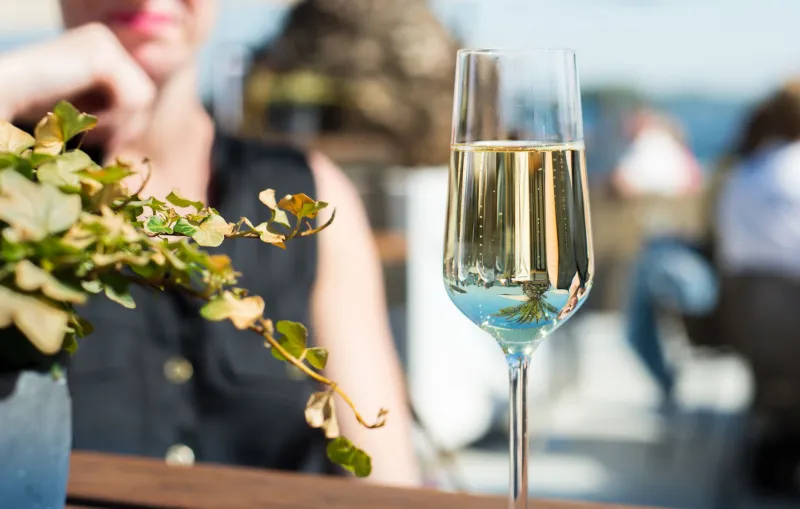
There is a particular kind of hesitation that happens at the wine bar when a guest's eyes travel across the sparkling section of the list. The pause is brief but telling. The hand moves, almost instinctively, toward the Chardonnay or the Pinot Noir — wines that feel, in the American imagination, like the appropriate choice for a quiet evening without ceremony. The sparkling wines sit there, patient and a little overlooked, waiting for a birthday that may not come.
This is a habit worth reconsidering.
Sparkling wine, in its many forms, is not a category built for milestones. It is a category built for pleasure — the kind of pleasure that does not require justification, a guest list, or a reason to clink glasses. The belief that bubbles must be earned is one of the more persistent and least useful ideas in American drinking culture, and the wine list at any thoughtful establishment offers ample evidence that it simply does not hold.
What the Celebration Myth Gets Wrong
The association between sparkling wine and special occasions is largely a product of marketing — specifically, decades of Champagne advertising that positioned bubbles as the language of luxury and achievement. Those campaigns were enormously effective. They also did a quiet disservice to an entire category of wine by suggesting that opening a bottle of fizz without cause was somehow excessive.
The irony is that in France, Spain, and much of Europe, sparkling wine is consumed with the same casual regularity as still wine. A glass of Crémant d'Alsace alongside a weeknight dinner is not a statement; it is simply a preference. A chilled Cava at a tapas bar in Barcelona is as unremarkable as ordering a lager at a neighborhood pub. The occasion is the meal itself — nothing more is required.
American wine culture is shifting in this direction, slowly but noticeably. The guests who arrive at Annabel's on a Wednesday and lead with a glass of Pét-Nat are not celebrating anything in particular. They have simply learned something that the rest of the room is still working out.
Three Sparkling Wines Worth Ordering Tonight
For those who have spent years treating the sparkling section as a special-occasion column, the range of what is available — and how approachable it can be — may come as a pleasant surprise.
Crémant is perhaps the most underappreciated entry point. Produced using the same traditional method as Champagne but sourced from regions across France — Burgundy, Alsace, the Loire Valley, and others — Crémant offers genuinely sophisticated bubbles at a price point that makes a second glass feel entirely reasonable. The wines tend toward elegance: fine, persistent bubbles, restrained fruit, and a mineral quality that pairs exceptionally well with the kind of small plates that anchor a wine bar menu. A Crémant de Bourgogne alongside a board of aged Comté or a dish of marinated olives is not a compromise. It is a considered choice.
Cava, Spain's answer to the traditional-method sparkling category, brings a slightly earthier character to the glass — notes of almond, citrus pith, and brioche that give it more textural presence than its price would suggest. Because Cava is produced primarily from indigenous Spanish grapes such as Macabeo, Xarel·lo, and Parellada, it carries a regional distinctiveness that rewards curiosity. It is also, practically speaking, one of the most food-friendly wines on any list, capable of navigating everything from charcuterie to fried dishes to hard cheeses without losing its footing.
Pét-Nat — short for Pétillant Naturel — occupies a different space entirely. Produced using the ancestral method, in which the wine is bottled before fermentation is complete, Pét-Nat tends to be lower in alcohol, slightly hazy, and refreshingly unpolished. It is the sparkling category's most approachable and, in many ways, most honest expression: less structured than Champagne, more expressive than most Cava, and possessed of a liveliness that makes it feel almost conversational. For guests who have been told that sparkling wine is formal, a well-chosen Pét-Nat is a useful corrective.
The Practical Argument for Ordering Bubbles First
Beyond the pleasure of the wine itself, there is a structural case for beginning an evening with a glass of sparkling rather than treating it as an afterthought or a celebratory flourish.
Sparkling wine is, by its nature, an aperitif. The acidity and effervescence stimulate the palate in a way that still wines do not, preparing the appetite for what follows and making the first bites of food taste sharper, more vivid. This is not merely a romantic notion — it is the reason that the aperitivo tradition, so deeply embedded in Italian and French dining culture, almost always involves something with bubbles.
Ordering a glass of Crémant or Cava as the evening begins also removes a certain pressure from the selection process. Rather than committing to a bottle of red or white before the full menu has been considered, a single glass of sparkling wine buys time and opens the palate simultaneously. It is, in the most practical sense, an excellent way to start.
Letting the Occasion Be the Glass Itself
There is a version of a Tuesday evening — or a Thursday, or a Sunday afternoon — that begins with a glass of something cold and effervescent, paired with a plate of something simple, in a room where the light is good and the company is easy. No announcement is necessary. No milestone is being observed. The occasion, if one is needed, is the glass itself.
The sparkling section of the wine list at Annabel's is not a waiting room for celebrations. It is an invitation, extended on any given evening, to drink something that moves — something with texture and energy and a kind of brightness that still wines, for all their virtues, cannot quite replicate.
Next time the eyes drift toward the familiar columns, it may be worth pausing on the bubbles. Not because there is something to celebrate, but because there does not need to be.