The Seat You Pick Tells the Story Before the Wine Even Arrives
Most guests spend considerable energy deliberating over their wine selection — debating between an Albariño and a Grüner Veltliner, weighing the merits of a half-pour versus a full glass. And yet, before any of that deliberation begins, a far more instinctive choice has already been made. The moment you step through the door and scan the room, you make a silent, revealing declaration: where you intend to land.
At Annabel's, we have observed thousands of guests navigate this decision, and we have come to believe that your seat tells us something your order simply cannot. It speaks to your intentions for the evening, the kind of company you keep, and the experience you are quietly hoping to have. Consider this a gentle, affectionate guide to what your preferred perch might reveal — and how to choose more deliberately next time.
The Bar Top: You Came Here to Connect
There is a particular kind of guest who gravitates immediately toward the bar, pulling out a stool without a second thought. They are not here merely to drink. They are here to participate. The bar top is the most socially charged seat in any wine bar, a place where conversations begin between strangers, where the sommelier becomes a collaborator rather than a server, and where the evening has an open-ended quality that a reserved corner table simply cannot replicate.
If you settle at the bar, you are signaling — perhaps unconsciously — that you are open to the unexpected. You want to ask questions about what's in the glass, hear about what just arrived from a small producer in the Finger Lakes, and possibly end the night having exchanged contact information with the couple seated two stools down. You are, in the best possible sense, a participant rather than an observer.
Practical note: The bar top is also the single best seat for solo visitors. It removes any awkwardness of dining alone and replaces it with the natural rhythm of a place in motion. If you have never visited a wine bar on your own, choose the bar and watch how quickly the evening fills itself.
The Window Seat: You Came Here to Be Seen — and to See
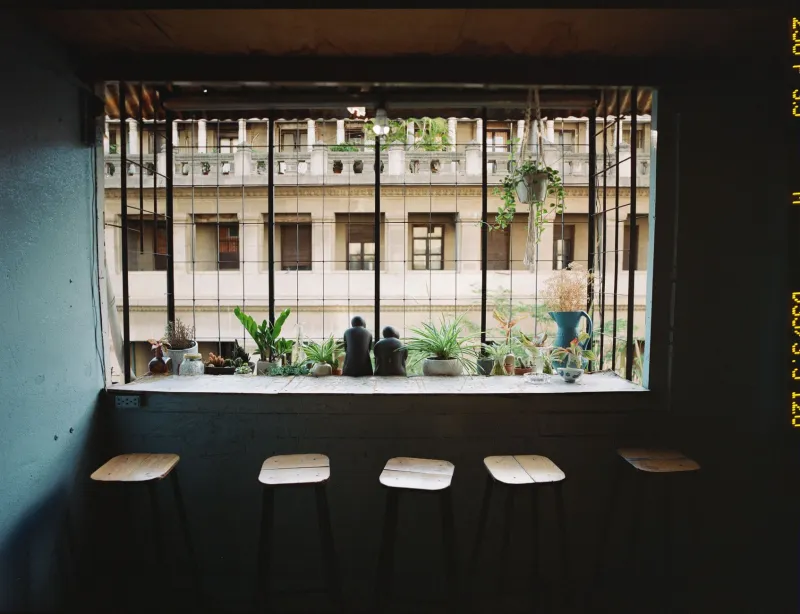
The guest who claims the window seat has a particular relationship with atmosphere. They want to exist within the room while remaining slightly apart from it — one eye on their companion, one eye on the street outside, absorbing the texture of the evening from a comfortable vantage point. This is not a criticism. It is, in fact, a sophisticated way to experience a wine bar.
Window seat guests tend to be romantics in the classical sense. They appreciate the way low light catches the color of a Burgundy in the glass, the way a quiet Tuesday evening on the street outside can feel cinematic when viewed through a fogged pane of glass. They are often on a date — first or fiftieth — or celebrating something that deserves a frame around it.
If this is you, lean into it. Order something visually striking. A deep garnet Nebbiolo or a luminous Chenin Blanc rewards the instinct for beauty that brought you to this seat in the first place.
The Communal Table: You Came Here to Belong to Something Larger
Not every wine bar offers a communal table, but in establishments that do, it draws a very specific kind of guest — someone who is comfortable with the slight unpredictability of shared space, who finds energy in proximity to strangers rather than anxiety. The communal table is the democratic heart of the modern wine bar, a place where a group of colleagues winds down beside a pair of graduate students and somehow the conversation eventually crosses the divide.
Guests who choose this seat tend to be adaptable, curious, and often more adventurous in their ordering than those who retreat to private tables. There is something about sitting in the open that loosens inhibitions and encourages experimentation. You are more likely to try the natural wine you cannot quite pronounce, more likely to ask your neighbor what they are drinking, more likely to leave with a recommendation you never expected.
Practical note: If you are arriving as a group larger than four, the communal table is often your most socially generous option. It keeps the energy high and prevents the gathering from folding inward on itself.
The Tucked-Away Corner: You Came Here to Disappear
And then there is the corner table — the most coveted, most requested, most fiercely defended seat in any wine bar worth its stemware. The guest who seeks this spot is not being antisocial. They are being intentional. They want a container for their evening, a defined space where the conversation can go anywhere without the ambient noise of the room pressing in.
Corner guests are often the most serious about what is in their glass. They have done some thinking before they arrived. They may have a specific bottle in mind, a particular style of evening mapped out. They are celebrating something quietly, working through something difficult, or simply protecting a rare stretch of unhurried time with someone who matters.
If you are the corner type, you already know it. The room orients itself around your chosen perch, and the evening becomes something you curate rather than something that happens to you.
Choosing Your Seat as an Act of Intention
Here is the broader invitation, and it is one we extend sincerely: before you follow the host to whatever table is available, take a moment to ask yourself what you actually want from the next few hours. Are you seeking conversation or quiet? Connection with strangers or intimacy with one person? The energy of the room or a refuge from it?
Your seat is not a trivial detail. It is the first decision of the evening, and it shapes every one that follows — the pace at which you order, the way your conversation unfolds, the likelihood that you linger over a second glass rather than rushing through the first.
At Annabel's, every seat has been considered with care, because we believe the right environment is as important as what fills your glass. So the next time you walk through the door, resist the impulse to simply take what is nearest. Look around. Know yourself. Choose accordingly.
The wine will taste better for it.