The Art of Finishing Well: Why the Cheese Course Should Close Every Wine Bar Evening
There is a particular moment near the end of a wine bar evening — plates cleared, the conversation settling into something more comfortable and unhurried — when a decision presents itself. The easy path leads to the check. The better path leads to the cheese course.
In American dining culture, dessert has long occupied the closing act, and not without reason. But at a wine bar specifically, where the entire evening is built around what is in the glass, there is a strong argument that a well-chosen selection of cheese — accompanied by one final, considered pour — is the more fitting conclusion. It extends the logic of the meal rather than departing from it. It gives the evening a proper ending rather than merely a stop.
This is not about indulgence for its own sake. It is about finishing with the same intentionality you brought to the beginning.
Why Cheese, and Why Last
The relationship between wine and cheese is among the most discussed and occasionally most misrepresented pairings in food culture. The popular wisdom — that any wine goes with any cheese — is both broadly true and ultimately unhelpful. The more useful truth is that certain combinations create something genuinely greater than either element alone, and the end of a meal is precisely when that alchemy is most worth pursuing.
Late in an evening, your palate has already been shaped by what came before. You have moved through courses, navigated a range of flavors, and arrived at a moment when something rich, complex, and slightly saline can serve as a kind of resolution. Cheese provides exactly that. Its fat content softens the finish of whatever wine remains in your glass. Its salt draws out fruit and depth. Its texture slows you down in a way that a slice of chocolate cake simply does not.
Beyond the sensory logic, there is a cultural precedent worth honoring. In France and much of Western Europe, the cheese course arrives before dessert — or in place of it entirely — as a matter of course. American dining is gradually catching up, and wine bars are leading that shift.
How to Build Your Closing Selection
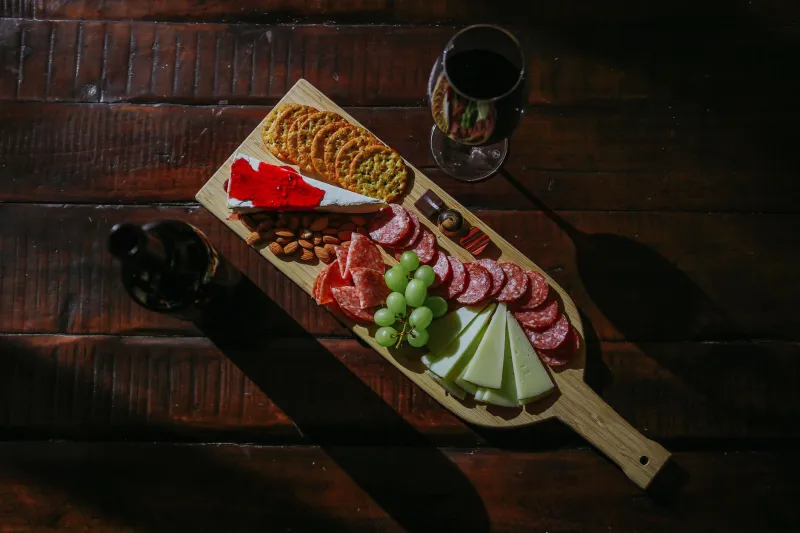
A closing cheese course need not be elaborate. Two or three selections, chosen with intention, will serve you far better than a crowded board assembled without a through line.
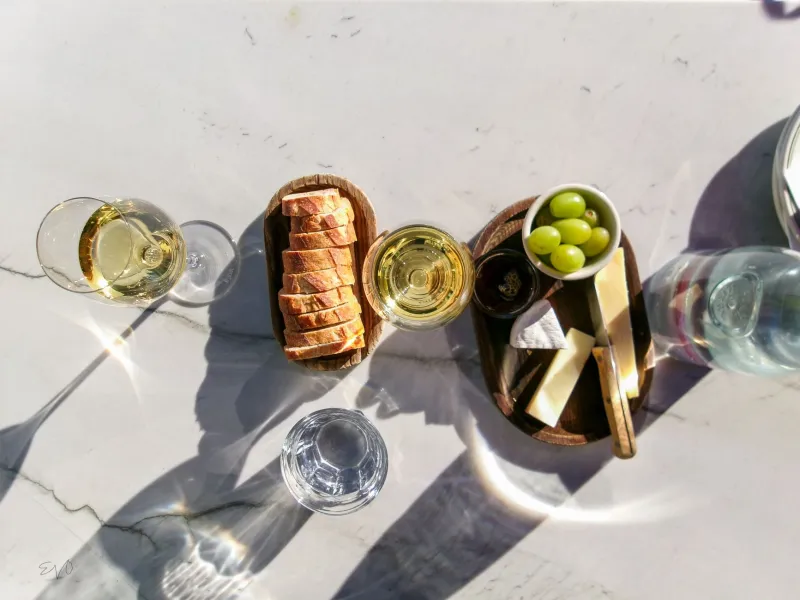
Start with contrast. Aim for at least one aged hard cheese — a domestic Parmesan-style, a well-aged Cheddar from Vermont or Wisconsin, or a Manchego-adjacent sheep's milk variety — alongside something softer and more yielding. A bloomy rind cheese such as a domestic Brie or Camembert-style brings a buttery, mushroomy quality that plays beautifully against the sharpness of an aged selection.
Consider adding a blue. This is not for everyone, and it should not be forced. But if your table is open to it, a good American blue — Rogue Creamery's Crater Lake Blue from Oregon, for instance, or Maytag Blue from Iowa — provides a salinity and intensity that pairs remarkably well with the sweet wines discussed below. If the table is adventurous, a blue is the most dramatic and rewarding note on which to close.
Do not neglect the accompaniments. Honey, particularly a darker varietal such as buckwheat, bridges the gap between aged cheese and sweet wine in a way that feels almost architectural. A few candied walnuts, some thinly sliced dried fruit, and a scattering of plain crackers give the selection room to breathe without overwhelming it.
The Final Pour: What to Choose
This is where the wine bar context becomes particularly meaningful. Your server or sommelier can guide you toward something specific, but it helps to arrive at the conversation with a few reference points in mind.
Late-harvest whites are among the most versatile options for a closing cheese pairing. A late-harvest Riesling — whether from the Finger Lakes, Washington State, or Alsace — brings honeyed stone fruit and bright acidity that cuts through the richness of bloomy rinds while complementing the nuttiness of aged selections. It is approachable, elegant, and rarely wrong.
Fortified wines deserve serious consideration. A good Tawny Port, with its notes of dried fig, caramel, and roasted nut, is one of the most classically reliable companions to aged hard cheese. If your table opted for a blue, a Tawny is not merely a suggestion — it is something close to a requirement. Similarly, a dry or off-dry Sherry, particularly an Amontillado or Oloroso, brings a complexity and saline quality that mirrors cheese in fascinating ways and is still criminally underordered at American wine bars.
A late-evening red can also work beautifully, particularly if you are staying with aged cheese only. A lighter-bodied Pinot Noir or a Grenache-forward blend with some bottle age will soften alongside the fat of the cheese without overpowering it. The key is to avoid anything too tannic, which will clash rather than harmonize.
The Permission to Linger
Perhaps the most important thing a cheese course offers is time. It is, by its nature, a slow experience. You are not meant to move quickly through it. You break off a small piece, you take a sip, you let the two things meet on your palate, and then you wait a moment before doing it again. The conversation that happens around a cheese course tends to be the best conversation of the evening — unhurried, reflective, the kind that only emerges when no one is in a hurry to leave.
At Annabel's, we believe that the close of an evening is as worthy of care as the opening. Reserving a few minutes — or a half hour, if the evening allows — for a proper cheese course and a final, well-chosen glass is not an extravagance. It is a habit. One that transforms a pleasant dinner into something you will find yourself looking forward to repeating.
Order the cheese. Pour one last glass. Stay a while longer. The evening will thank you for it.