Glass or Bottle: The Ordering Question That Actually Has a Right Answer—Depending on the Night
At some point in nearly every wine bar visit, the question surfaces—sometimes spoken aloud, sometimes resolved silently before the server arrives: glass or bottle? For many guests, the answer has already been decided before they sit down, shaped by habit, by the number of people at the table, or by a vague sense of what the evening is supposed to look like. But treating this as a default rather than a decision is, in many ways, a missed opportunity.
The choice between a by-the-glass pour and a full bottle is not merely logistical. It shapes the arc of the evening, the range of what you taste, the pace at which you drink, and—perhaps most importantly—the kind of experience you walk away with. Getting it right requires a moment of honest reflection about what the night actually calls for.
The Case for Ordering by the Glass
The by-the-glass list exists for reasons that go well beyond convenience. At its best, it is a curated tasting menu in miniature—a set of options that allows a guest to move across styles, regions, and producers in the course of a single evening without committing to any one of them.
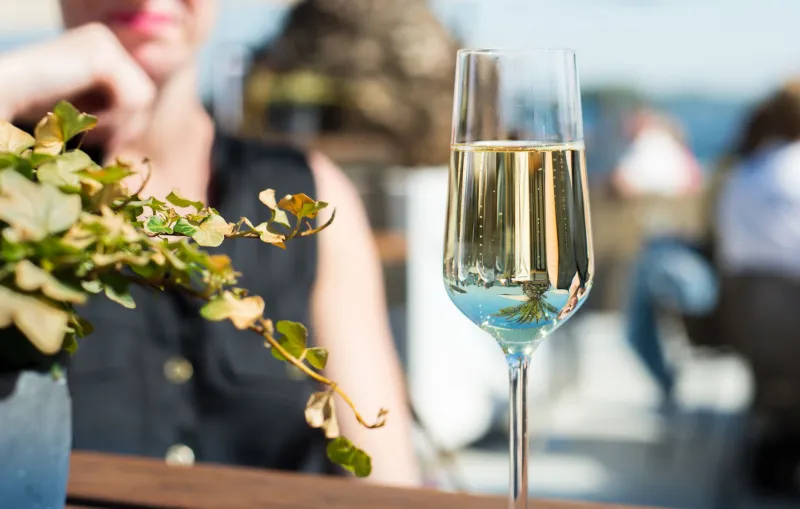
For the guest who arrives at the bar with an appetite for exploration, the by-the-glass format is genuinely liberating. A Vermentino to open, something with a little more structure to carry through the cheese course, perhaps a late-harvest Riesling to close—this kind of deliberate progression is only possible when each pour is a fresh decision. The bottle, for all its virtues, forecloses this kind of movement.
There is also an argument for the glass that has nothing to do with variety and everything to do with occasion. A solo guest arriving on a Wednesday evening for an hour of quiet is not in the market for a bottle. Nor is the couple who stopped in on impulse after dinner elsewhere, wanting something to extend the night without committing to another full experience. In these moments, the glass is not a lesser choice—it is precisely the right one.
And for the guest who is still building their wine vocabulary, the by-the-glass list offers something invaluable: the chance to be wrong without consequence. Ordering a glass of something unfamiliar and discovering it doesn't suit your palate is an education. Ordering a bottle of the same thing and feeling obligated to finish it is something else entirely.
The Case for the Bottle
And yet there are evenings when the bottle is not just the better choice but the only one that makes sense.
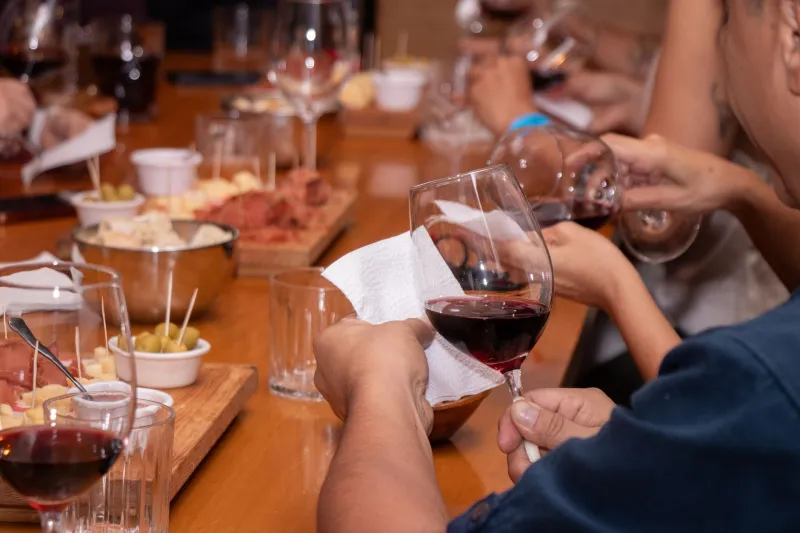
Consider the party of four settling in for a long Friday dinner. The by-the-glass list, however well-constructed, was not designed to serve four people through multiple courses. The math alone favors the bottle: four guests each ordering two glasses will spend meaningfully more than they would on a single bottle of comparable quality, and they will do so without the consistency that comes from a single, uninterrupted pour.
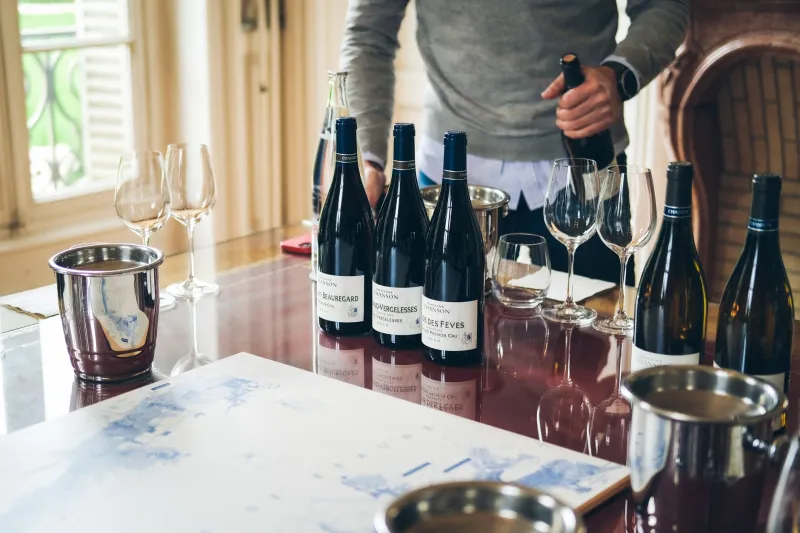
Beyond economics, there is something ceremonial about the bottle that a succession of individual glasses cannot replicate. The ritual of the presentation, the shared decision about what to choose, the way a bottle anchors a table and gives the evening a kind of narrative unity—these are real pleasures, and they belong to the bottle in a way that the glass, for all its flexibility, cannot claim.
The bottle also rewards patience. A wine that opens one way at the first pour may reveal something entirely different thirty minutes later, after it has had time to breathe and the temperature has shifted slightly. The guest who orders by the glass rarely experiences this evolution. The guest who commits to a bottle does, and what they discover in that second or third pour is often the most interesting thing they taste all evening.
When the Rules Break Down
The more nuanced truth is that neither format is universally superior, and the most rewarding wine bar experiences often involve a willingness to break with whatever default you arrived with.
Consider the couple who typically orders by the glass but finds, midway through the evening, that they have each ordered the same wine twice in a row. The server's gentle suggestion—at this point, a bottle would serve you better—is not a sales pitch. It is sound advice, and accepting it transforms what might have been a series of individual decisions into a shared commitment that changes the texture of the evening.
Consider also the group of three that arrives intending to split a bottle, only to discover that one person wants a white, one wants a red, and the third is genuinely uncertain. The by-the-glass list, in this scenario, is not a fallback—it is a solution, one that honors each guest's preferences without forcing a compromise that satisfies no one.
At Annabel's Wine Bar, the staff is trained to read these moments and offer guidance without pressure. The goal is never to steer guests toward a particular price point but to help them identify what the evening actually requires. Sometimes that means suggesting a half bottle—a format that occupies a genuinely useful middle ground between the glass and the full bottle, and one that deserves far more consideration than it typically receives.
A Framework Worth Keeping
If a simple framework is useful, consider this: order by the glass when the evening is about exploration, spontaneity, or brevity. Commit to a bottle when the evening is about depth, ceremony, or a group that has already found its footing. And when neither option fits cleanly, ask your server—not because you don't know what you want, but because the person who built the list likely has a suggestion that will make the question feel obvious in retrospect.
The glass and the bottle are not rivals. They are different instruments for different occasions, and knowing which one the night is calling for is, in its own small way, the beginning of drinking well.