Putting Down the Phone and Picking Up the Glass: How Wine Bars Are Becoming America's Favorite Escape
Putting Down the Phone and Picking Up the Glass: How Wine Bars Are Becoming America's Favorite Escape
There is a particular kind of exhaustion that no amount of sleep quite resolves. It accumulates not in the muscles but somewhere closer to the center of attention — a fatigue born of too many tabs, too many alerts, too many algorithmically curated feeds demanding engagement at every waking hour. Americans know this feeling intimately. And increasingly, they are doing something rather deliberate about it.
They are going to wine bars.
Not simply for the wine — though the wine is, of course, very much part of it — but for what a thoughtfully designed wine bar environment offers that a smartphone screen categorically cannot: stillness, curation, and the quiet luxury of a single, considered choice.
The Tyranny of Infinite Options
Psychologists have long studied what is known as decision fatigue — the measurable deterioration in the quality of decisions made after a long session of choosing. The average American adult makes thousands of micro-decisions each day, many of them driven by digital interfaces engineered to maximize engagement rather than satisfaction. The result is a population that is simultaneously overstimulated and deeply under-nourished in terms of genuine experience.
A wine list, by contrast, is a finite document. It has a beginning and an end. Its options have been curated by a human being with considered taste and intentional purpose. When a guest at Annabel's Wine Bar opens the evening's list, they are not confronted with an endless scroll of possibilities ranked by an opaque algorithm. They are offered a selection — perhaps thirty wines by the glass, perhaps more — each chosen with the deliberate care of someone who has thought carefully about what belongs in that particular space on that particular evening.
That distinction matters more than it might initially appear.
The Psychology of Choosing Presence
Researchers at the University of Texas at Austin published findings suggesting that the mere presence of a smartphone on a desk — even face down, even silenced — measurably reduces available cognitive capacity. The brain, it seems, cannot fully commit to the present moment so long as it remains tethered to the device's potential demands.
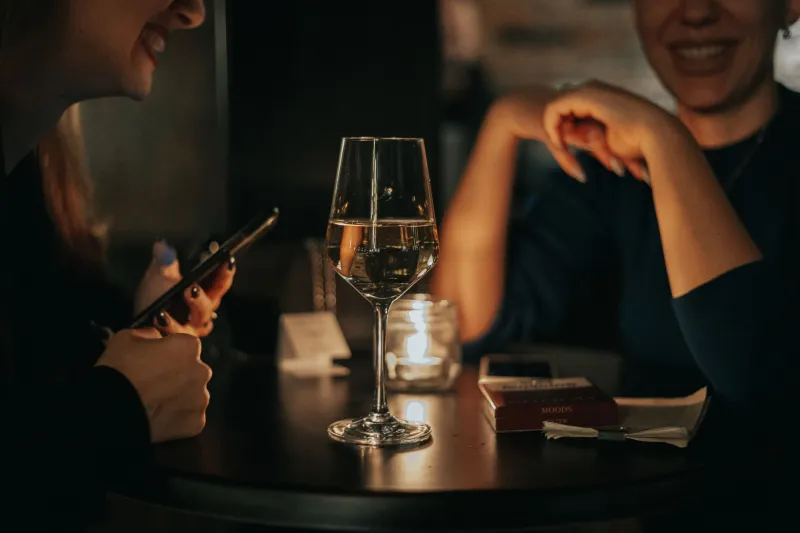
This is precisely why the ritual of setting a phone aside upon entering a wine bar carries weight beyond the symbolic. It is not a performance of mindfulness. It is a physiological recalibration. The moment the screen goes dark and the glass is lifted, the nervous system is offered something it has been denied all day: permission to simply be where it is.
At Annabel's Wine Bar, the environment is designed with this reality in mind. The lighting is warm enough to render screens less appealing. The acoustics invite conversation rather than isolation. The pacing of service encourages guests to settle rather than rush. None of these elements are accidental. They are the architecture of intentional presence.
What the Pour Actually Offers
Wine, consumed thoughtfully, is an inherently sensory experience — one that engages smell, taste, sight, and even touch in ways that demand a measure of attention. A well-made Burgundy does not reward distraction. A glass of aged Rioja does not reveal its secondary notes to someone whose eyes are fixed on a notification banner.
This is not elitism. It is simply the nature of the experience. Wine has always been a beverage that asks something of its drinker — not expertise, not credentials, but a willingness to pay attention. In that sense, it is almost perfectly calibrated as an antidote to the digital age.
Guests who arrive at Annabel's Wine Bar in the early stages of an evening often describe a particular transition that occurs somewhere between the first and second glass. The shoulders drop. The conversation deepens. The impulse to check the phone diminishes not through discipline but through displacement — something more interesting has taken its place.
The Table as a Different Kind of Connection
There is a social dimension to this shift that deserves acknowledgment. Much of what Americans consume digitally is, nominally, social in nature — messages, posts, reactions, feeds populated by the lives of others. And yet the research on loneliness in the United States paints a picture of a population that is, paradoxically, more connected and more isolated than at any previous point in recorded history.
The wine bar, at its best, offers a corrective to that paradox. It places people in physical proximity, removes the buffer of screens, and provides a shared focal point — the wine, the food, the room itself — around which genuine exchange can organize itself. Conversations that begin with a question about what is in the glass have a way of ending somewhere far more meaningful.
At Annabel's, this is not incidental to the experience. It is, in many ways, the point.
How to Make the Most of Your Visit
For those who find the prospect of a phone-free evening more anxiety-inducing than it perhaps should be, a few practical considerations may ease the transition.
Arrive with intention. Before you walk through the door, make any necessary communications and set an out-of-office posture for the next two hours. Inform the people who might need you that you are unavailable. Then make yourself unavailable.
Let the list be your first conversation. Rather than defaulting to a familiar order, ask your server or sommelier what is interesting on the list that evening. This single question opens an exchange that no app can replicate.
Resist the impulse to document. The photograph of the glass will never capture what the glass actually tastes like. The memory of a genuinely good evening, held in the body rather than stored in a camera roll, tends to last considerably longer.
Order something you cannot pronounce. Uncertainty is, in this context, an asset. It creates the conditions for curiosity, and curiosity is the enemy of the restless, scrolling mind.
Stay for one more glass than you planned. The best part of any wine bar evening is almost always the portion that was not scheduled.
A Counterculture Worth Joining
It would be easy to frame the wine bar as an escape — and in one sense, it is. But the more accurate framing may be that it is a return. A return to the pace at which human beings were designed to operate. A return to the pleasures of the senses, the conversation, and the unhurried hour.
In choosing to spend an evening at a place like Annabel's Wine Bar rather than on the couch with a device, Americans are not opting out of the world. They are opting back into it — the version of it that exists in a room, between people, over something worth tasting slowly.
The pour is waiting. The phone can wait, too.