Small Format, Grand Ambition: The Case for Embracing the Half Bottle
There is a particular kind of confidence that comes with ordering small. Not the hesitance of someone unsure what they want, but the deliberate restraint of someone who knows precisely how they intend to spend the next few hours. The half bottle — 375 milliliters, exactly half a standard pour — occupies a curious position in American wine culture. It is simultaneously overlooked by the casual diner and quietly cherished by those who understand what it actually offers.
At Annabel's, we believe an evening at a wine bar should unfold, not simply begin and end. The half bottle is perhaps the single most effective tool for ensuring that it does.
What the Half Bottle Actually Is
Before making the case for it, a brief clarification is worthwhile. The half bottle, sometimes called a demi, contains 375ml of wine — enough for two generous pours or three more measured ones. It is a distinct product from a split (187ml, typically sparkling) and should not be confused with the by-the-glass format, which pours from an already-opened standard bottle. A half bottle is sealed, often cork-finished, and aged as its own entity from the moment it leaves the winery.
That last point matters more than most people realize.
The Aging Question: Why Smaller Can Mean Faster
Wine ages in relation to the amount of oxygen present relative to the volume of liquid. Because a half bottle contains proportionally more headspace — and because the cork-to-wine ratio is effectively doubled compared to a standard 750ml — the wine inside evolves at a faster rate. This is not a flaw. It is a characteristic that, properly understood, opens up remarkable possibilities.
A Bordeaux that might need a decade to reach its expressive peak in a standard bottle may arrive at a similar place in a half bottle within five or six years. For the wine bar guest who does not maintain a personal cellar, this acceleration is genuinely useful. It means that well-aged half bottles, when a list carries them, offer a window into mature wine without the long wait or the significant investment of a full bottle at peak drinking age.
Conversely, wines intended for immediate enjoyment — a bright Vermentino, a lightly chilled Beaujolais, a crisp Grüner Veltliner — lose nothing in the smaller format and gain the distinct advantage of being consumed entirely fresh, with no lingering concern about the second half of the bottle sitting open while the evening winds down.
The Varietals That Genuinely Shine
Not every wine translates equally to the half bottle format, and part of the pleasure of understanding this vessel is knowing which grapes reward it most.
Riesling, particularly from Alsace or Germany's Mosel region, is arguably the half bottle's finest companion. The grape's naturally high acidity preserves it beautifully, and the accelerated aging in the smaller format tends to bring forward the honeyed, petrol-tinged complexity that makes aged Riesling so arresting. A five-year-old Spätlese in a half bottle can drink like something far more evolved.
Sauternes and late-harvest dessert wines have long been bottled in the half format as a practical matter — a full bottle of something as intensely sweet as a Sauternes is simply more than most tables require. Here, the half bottle is the correct vessel, not the diminished one.
Pinot Noir, especially from Burgundy or Oregon's Willamette Valley, also performs admirably. The grape's relative delicacy means it benefits from the slightly accelerated development, and the format encourages the kind of unhurried, attentive sipping that Pinot Noir deserves.
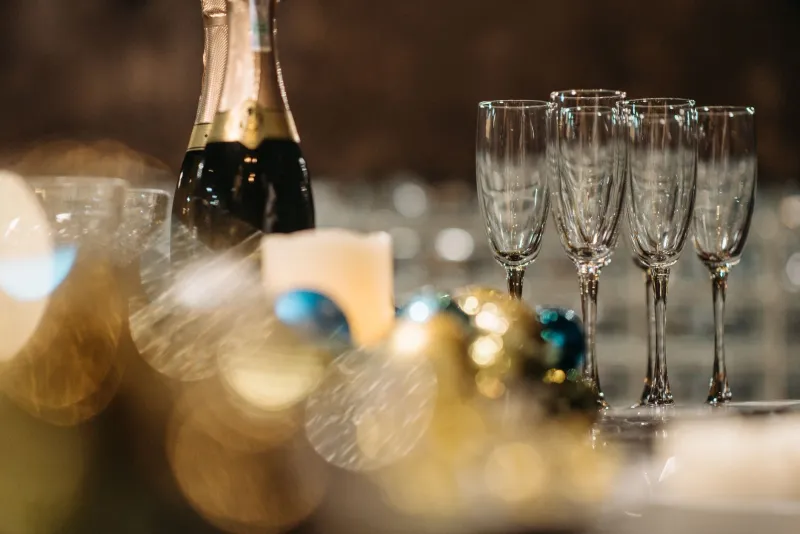
Champagne and sparkling wines in the half bottle format are underutilized at American wine bars, which is a genuine shame. A half bottle of a quality grower Champagne is a perfect aperitif for two — complete, celebratory, and finished before the appetite it is meant to stimulate has fully arrived.
How to Spot Them on a List
Half bottles are not always prominently featured. On many American wine lists, they appear as a brief subsection beneath the full bottle offerings, occasionally labeled by volume (375ml) rather than by the term "half bottle." Some lists integrate them directly alongside their standard counterparts, noting the format in parentheses.
The presence of a thoughtfully curated half bottle section on a list is itself a signal worth noting. It suggests a program that has been constructed with the guest's experience in mind — specifically, the guest who wishes to explore. A list that offers four or five well-chosen half bottles is telling you something about the establishment's priorities.
When in doubt, ask. A knowledgeable server or sommelier will not only confirm what half bottles are available but may well steer you toward something that has been quietly aging in the cellar, waiting for exactly this kind of inquiry.
The Real Argument: An Evening That Moves
Here is the most compelling case for the half bottle, stated plainly: it gives your evening permission to move.
A standard 750ml bottle, shared between two people, commits you to roughly three to four glasses each of the same wine. This is a perfectly fine way to spend an evening, but it is not an exploratory one. The half bottle, consumed over the same comfortable pace, leaves room — in both the glass and the appetite — for something else to follow.
Consider the structure this enables. A half bottle of something bright and mineral to open, perhaps alongside a board of charcuterie. A half bottle of something richer and more textured to accompany a cheese course. The evening has a shape now. It has movement and intention. You have, in effect, constructed a tasting menu from the bottle list without ever ordering a flight.
This is precisely the kind of evening that a wine bar is designed to provide. The half bottle is simply the most elegant mechanism for achieving it.
A Note on Value
It would be incomplete to discuss the half bottle without acknowledging the economics. Half bottles are not priced at exactly half the cost of a full bottle — production, labeling, and storage costs do not scale proportionally. You will typically pay somewhere between 55 and 65 percent of the full bottle price for a half. Over the course of an evening where you order two half bottles rather than one full, you may spend slightly more in total.
The question worth asking is whether the additional range — the second wine, the second experience, the richer conversation that tends to follow from genuine variety — is worth that modest premium. For those who visit a wine bar not merely to drink but to discover, the answer is almost always yes.
The half bottle is not a concession. It is a strategy. And on any evening you choose to employ it, you will likely find that the night opens up in ways a single, larger bottle never quite could.